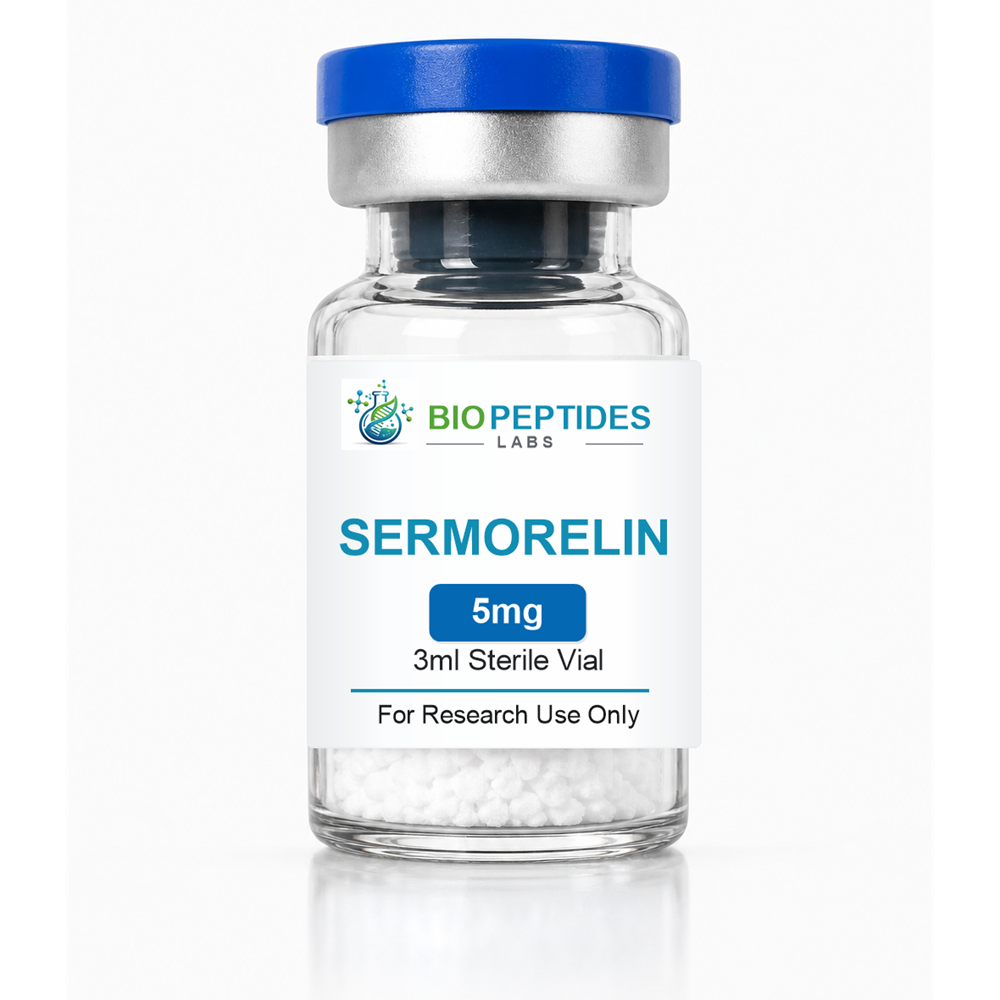
Sermorelin 5mg
$34.99
Sermorelin | 5mg | Research Peptide
What is Sermorelin?
Sermorelin (also known as GHRH 1-29 NH₂) is a synthetic peptide analog consisting of 29 amino acids, representing the biologically active N-terminal fragment of endogenous growth hormone releasing hormone (GHRH). The full-length native GHRH peptide consists of 44 amino acids, however research has established that the first 29 amino acids of the sequence contain the complete receptor-binding domain responsible for GHRH's biological activity, making Sermorelin the shortest fully active fragment of GHRH capable of stimulating growth hormone (GH) secretion from the anterior pituitary gland.
First synthesized and studied in the 1970s and 1980s, Sermorelin was among the earliest GHRH analogs developed for research purposes and has since accumulated one of the most comprehensive preclinical and clinical research profiles of any GH-stimulating peptide. Unlike direct growth hormone secretagogues such as GHRP-2 or Ipamorelin, which act on the GHSR-1a receptor through a ghrelin-mimetic mechanism, Sermorelin works exclusively through the GHRH receptor (GHRHR) — a distinct receptor pathway that stimulates GH release in a manner that closely mirrors the body's natural pulsatile GH secretion rhythm. This physiologically aligned mechanism of action has made Sermorelin particularly valuable in research contexts where the preservation of natural GH pulsatility and hypothalamic-pituitary axis integrity is of primary scientific interest.
Sermorelin's well-documented synergy with GHSR-1a agonists such as GHRP-2 and Ipamorelin — whereby co-administration produces significantly amplified GH release compared to either compound alone — has further cemented its status as a foundational research tool in growth hormone biology. Its favorable stability profile, predictable dose-response characteristics, and decades of accumulated research data across growth hormone biology, metabolic science, anti-aging research, and neuroendocrinology have established Sermorelin as one of the most important and widely utilized peptides in the GH research landscape.
Overview
Sermorelin is a synthetic 29-amino acid analog of endogenous growth hormone releasing hormone (GHRH) that stimulates pituitary GH secretion through direct GHRH receptor activation — closely mimicking the body's natural GH release rhythm. With one of the most extensive preclinical and clinical research profiles among GH-stimulating peptides, and a well-established synergistic relationship with GHSR-1a agonists, Sermorelin remains a cornerstone research compound in growth hormone biology, metabolic science, and neuroendocrinological research.
Product Details
Peptide: Sermorelin (GHRH 1-29 NH₂)
Type: Growth Hormone Releasing Hormone Analog / Synthetic Peptide / 29-mer
Sequence: Tyr-Ala-Asp-Ala-Ile-Phe-Thr-Asn-Ser-Tyr-Arg-Lys-Val-Leu-Gly-Gln-Leu-Ser-Ala-Arg-Lys-Leu-Leu-Gln-Asp-Ile-Met-Ser-Arg-NH₂
Molecular Formula: C₁₄₉H₂₄₆N₄₄O₄₂S
Molecular Weight: 3357.93 g/mol
CAS Number: 86168-78-7
Quantity: 5mg
Appearance: Lyophilized white powder
Purity: ≥99% (HPLC verified)
Reconstitution Fluid: Bacteriostatic Water (BW) or Sterile Saline (0.9% NaCl)
Storage: Store lyophilized peptide at -20°C. Upon reconstitution, store at 4°C and use within 30 days. Avoid repeated freeze-thaw cycles. Protect from light.
Research Applications
Sermorelin has been extensively studied in preclinical and clinical models for its potential roles in:
Growth Hormone Secretion Research — Investigated for its selective activation of pituitary GHRH receptors and its ability to stimulate pulsatile GH release in a physiologically aligned manner, preserving the natural rhythm and feedback regulation of the hypothalamic-pituitary-somatotropic axis.
GHRH Receptor Biology — As the shortest fully active fragment of endogenous GHRH, Sermorelin is widely used as a primary research tool for studying GHRH receptor binding dynamics, receptor expression patterns, and downstream intracellular signaling cascades in pituitary tissue models.
Synergistic GH Stimulation Research — Studied extensively for its potent synergistic amplification of GH release when co-administered with GHSR-1a agonists such as GHRP-2 and Ipamorelin, producing significantly greater GH output than either compound alone through complementary dual-receptor pathway activation.
IGF-1 Regulation Research — Investigated for its downstream influence on insulin-like growth factor-1 (IGF-1) production in hepatic tissue, a primary mediator of GH's anabolic, regenerative, and metabolic effects in peripheral tissues.
Hypothalamic-Pituitary Axis Research — Studied as a research tool for investigating the integrity and responsiveness of the hypothalamic-pituitary-somatotropic axis, including feedback regulation mechanisms and somatostatin interplay in GH secretion models.
Body Composition Research — Preclinical and clinical models have explored Sermorelin's potential influence on lean muscle mass, adipose tissue metabolism, and overall body composition through GH and IGF-1 mediated anabolic and lipolytic pathways.
Bone Density Research — Studies have examined Sermorelin's effects on bone mineral density and osteoblast activity through GH and IGF-1 mediated pathways, with particular interest in age-related bone loss and osteoporosis research models.
Anti-Aging & Longevity Research — As endogenous GHRH signaling and GH secretion decline significantly with advancing age, Sermorelin is widely used as a research tool for investigating GHRH restoration strategies and their effects on age-related metabolic, musculoskeletal, cognitive, and physiological decline.
Sleep & Circadian Biology — Investigated for its influence on GH release during slow-wave sleep stages, given the well-established correlation between GHRH signaling, deep sleep architecture, and nocturnal GH pulsatility in animal and clinical models.
Cardiovascular Research — Emerging preclinical research has explored the potential cardioprotective and vascular effects of GHRH receptor activation, including Sermorelin's influence on cardiac function, vascular tone, and endothelial health in metabolic disease models.
Research Notes
Sermorelin is a research chemical intended strictly for laboratory and in vitro/in vivo research use only. It is not approved for human consumption, therapeutic use, or veterinary application outside of licensed medical settings. All data and findings referenced are sourced from peer-reviewed preclinical and clinical studies.
Handling & Reconstitution (For Research Use)
For research purposes, Sermorelin lyophilized powder is typically reconstituted using bacteriostatic water or sterile saline. Add reconstitution fluid slowly by directing it to the side of the vial and swirling gently — do not shake. Handle under sterile conditions and avoid repeated freeze-thaw cycles to maintain peptide integrity and potency. Protect reconstituted solution from direct light exposure.
Disclaimer
This product is sold for research and laboratory use only. Not for human or animal consumption. Not intended to diagnose, treat, cure, or prevent any disease. Must be handled by qualified researchers in accordance with all applicable laws and regulations.