
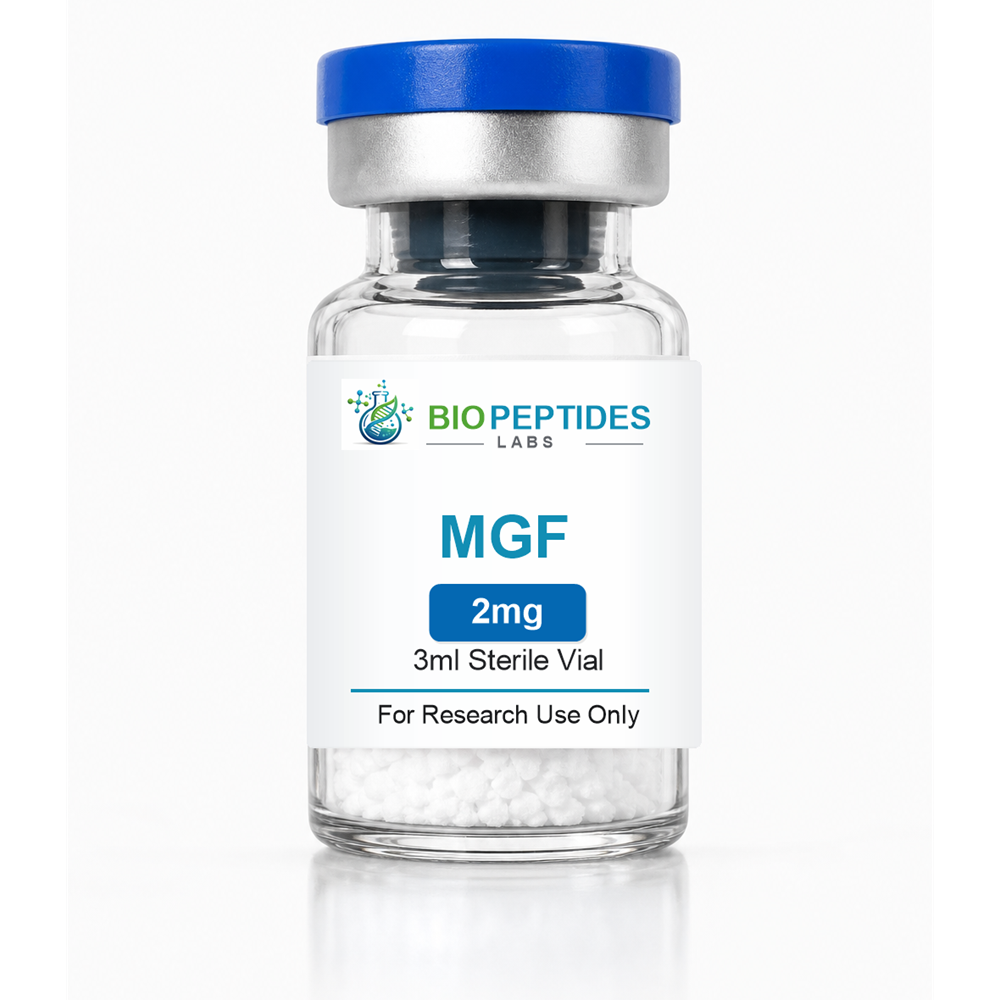
MGF 2mg
$34.99
MGF | 2mg | Research Peptide
What is MGF?
MGF (Mechano Growth Factor) is a splice variant of insulin-like growth factor-1 (IGF-1), produced locally in muscle and other tissues in response to mechanical stress, exercise, or tissue damage. Specifically, MGF is derived from the IGF-1 gene through alternative splicing of exon 5, resulting in a unique peptide with a distinct C-terminal extension sequence that differentiates it from other IGF-1 splice variants such as IGF-1Ea and IGF-1Ec. The synthetic research form most commonly studied is PEGylated MGF (PEG-MGF), though the native form remains widely used across in vitro and in vivo research models for its more immediate and localized biological activity profile.
MGF was first identified and characterized by Professor Geoffrey Goldspink and colleagues at University College London in the late 1990s, where it was discovered to play a distinct and critical role in the activation and proliferation of muscle satellite cells — a specialized population of stem-like progenitor cells responsible for muscle repair and regeneration following injury or mechanical overload. Unlike systemic IGF-1, which circulates broadly throughout the body, MGF acts primarily in a local, autocrine and paracrine manner at the site of tissue stress or damage, making its mechanism of action highly targeted and site-specific. This local activity profile has driven significant research interest across muscle biology, tissue engineering, orthopedic research, and regenerative medicine. Preclinical studies conducted in rodent and in vitro models have investigated MGF's effects on satellite cell activation, myoblast proliferation, neuroprotection, and cardiac tissue repair, establishing it as one of the most compelling peptides in the field of regenerative biology research.
Overview
MGF is a locally acting splice variant of IGF-1 that plays a distinct and critical role in satellite cell activation, muscle repair, and tissue regeneration following mechanical stress or injury. Its highly targeted autocrine and paracrine mechanism of action, combined with a well-established preclinical research profile spanning muscle biology, neuroprotection, and cardiac repair, has made MGF one of the most studied peptides in regenerative medicine and tissue engineering research.
Product Details
Peptide: MGF (Mechano Growth Factor)
Type: IGF-1 Splice Variant / Locally Acting Growth Factor Peptide
Molecular Formula: C₁₂₁H₂₀₀N₄₂O₃₉
Molecular Weight: 2867.14 g/mol
CAS Number: 185051-75-6
Quantity: 2mg
Appearance: Lyophilized white powder
Purity: ≥99% (HPLC verified)
Reconstitution Fluid: Bacteriostatic Water (BW) or Sterile Saline (0.9% NaCl)
Storage: Store lyophilized peptide at -20°C. Upon reconstitution, store at 4°C and use within 30 days. Avoid repeated freeze-thaw cycles. Protect from light.
Research Applications
MGF has been extensively studied in preclinical models for its potential roles in:
Muscle Satellite Cell Activation Research — Investigated for its primary and most well-characterized mechanism of activating quiescent muscle satellite cells following mechanical stress or tissue damage, initiating the proliferative phase of muscle repair and regeneration in animal models.
Skeletal Muscle Repair & Regeneration — Studied for its role in promoting myoblast proliferation, differentiation, and myofiber repair in preclinical models of muscle injury, atrophy, and age-related muscle decline.
Tissue Engineering Research — MGF's potent satellite cell activation properties have made it a valuable tool in tissue engineering research, particularly in studies focused on developing regenerative scaffolds and bioengineered muscle constructs.
Neuroprotective Research — Preclinical studies have investigated MGF's neuroprotective properties, including its ability to promote neuronal survival, reduce apoptosis, and support axonal regeneration in models of neurological injury and neurodegenerative disease.
Cardiac Tissue Repair Research — Emerging research has explored MGF's potential to promote cardiomyocyte survival and cardiac tissue repair in preclinical models of myocardial injury and ischemia, where IGF-1 receptor activation plays a cardioprotective role.
IGF-1 Splice Variant Biology — As a distinct splice variant of IGF-1 with a unique C-terminal peptide sequence, MGF is studied as a research tool for investigating the differential roles of IGF-1 isoforms in tissue-specific growth factor signaling and receptor binding dynamics.
Age-Related Muscle Decline Research — Studies have examined the decline of MGF expression in aging muscle tissue and its relationship to sarcopenia, with research exploring MGF supplementation as a potential strategy for investigating age-related loss of muscle regenerative capacity.
Bone & Connective Tissue Research — Investigated for its potential influence on osteoblast activity and connective tissue repair through local IGF-1 receptor mediated signaling in bone and tendon tissue models.
Research Notes
MGF is a research chemical intended strictly for laboratory and in vitro/in vivo research use only. It is not approved for human consumption, therapeutic use, or veterinary application. All data and findings referenced are sourced from peer-reviewed preclinical studies.
Handling & Reconstitution (For Research Use)
For research purposes, MGF lyophilized powder is typically reconstituted using bacteriostatic water or sterile saline. Add reconstitution fluid slowly by directing it to the side of the vial and swirling gently — do not shake. Handle under sterile conditions and avoid repeated freeze-thaw cycles to maintain peptide integrity and potency. Protect reconstituted solution from direct light exposure.
Disclaimer
This product is sold for research and laboratory use only. Not for human or animal consumption. Not intended to diagnose, treat, cure, or prevent any disease. Must be handled by qualified researchers in accordance with all applicable laws and regulations.