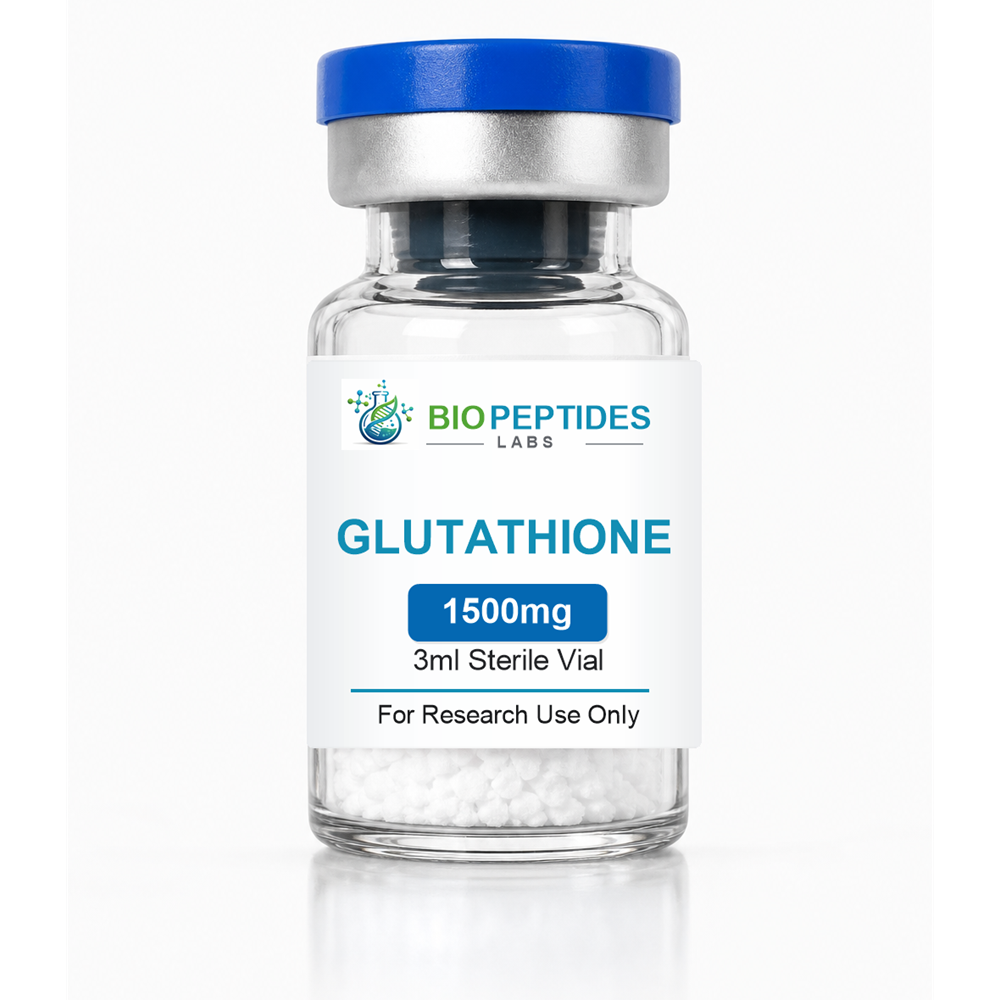
Glutathione 1500mg
$39.99
Glutathione | 1500mg | Research Compound
What is Glutathione?
Glutathione (GSH) is a naturally occurring tripeptide consisting of three amino acids — Glutamic Acid (Glu), Cysteine (Cys), and Glycine (Gly) — with the sequence γ-Glu-Cys-Gly. It is the most abundant endogenous antioxidant molecule found in virtually every cell of the human body, with particularly high concentrations in the liver, lungs, kidneys, and immune cells. Unlike exogenous antioxidants consumed through diet or supplementation, glutathione is synthesized intracellularly through a tightly regulated two-step enzymatic process, making it unique among biological antioxidant systems in its capacity for continuous intracellular regeneration and recycling.
First identified in the early 20th century and extensively characterized throughout the latter half of the 1900s, glutathione occupies a central and irreplaceable position in cellular biochemistry. Its biological functions extend far beyond simple free radical scavenging — glutathione serves as a master regulator of the intracellular redox environment, a critical cofactor in Phase II hepatic detoxification, a primary mediator of immune cell proliferation and function, a key participant in DNA synthesis and repair, and an essential component of numerous enzymatic reactions across virtually every metabolic pathway in the cell. The ratio of reduced glutathione (GSH) to oxidized glutathione (GSSG) within the cell is widely regarded by researchers as one of the most sensitive and reliable indicators of overall cellular health, oxidative stress load, and metabolic integrity.
Glutathione's extraordinary biological importance has driven decades of intensive research across multiple disciplines including toxicology, immunology, oncology, neuroscience, hepatology, and aging biology. Its central role in oxidative stress regulation, combined with the well-documented decline of intracellular glutathione levels associated with aging, chronic disease, and environmental toxin exposure, has made it one of the most studied molecules in modern biomedical research. The 1500mg research presentation provides investigators with a substantial quantity suitable for extended research protocols across a wide range of in vitro and in vivo study designs.
Overview
Glutathione is the body's most abundant endogenous antioxidant tripeptide, functioning as a master regulator of intracellular redox balance, a critical hepatic detoxification cofactor, and a key mediator of immune function and cellular integrity. With one of the most extensive and well-characterized research profiles of any biological molecule, glutathione remains a foundational compound across toxicology, immunology, oncology, neuroscience, and aging research.
Product Details
Compound: Glutathione (GSH / L-Glutathione Reduced)
Type: Endogenous Tripeptide / Master Antioxidant
Sequence: γ-Glu-Cys-Gly
Molecular Formula: C₁₀H₁₇N₃O₆S
Molecular Weight: 307.32 g/mol
CAS Number: 70-18-8
Quantity: 1500mg
Appearance: Lyophilized white powder
Purity: ≥99% (HPLC verified)
Reconstitution Fluid: Bacteriostatic Water (BW) or Sterile Saline (0.9% NaCl)
Storage: Store lyophilized compound at -20°C in an airtight, moisture-free container. Upon reconstitution, store at 4°C protected from light and use within 14 days. Avoid repeated freeze-thaw cycles. Glutathione is sensitive to oxidation — minimize air exposure during handling.
Research Applications
Glutathione has been extensively studied in preclinical and clinical models for its potential roles in:
Oxidative Stress & Redox Biology Research — Investigated as the primary intracellular antioxidant system responsible for neutralizing reactive oxygen species (ROS), reactive nitrogen species (RNS), and lipid peroxides, with the GSH/GSSG ratio used as a primary research marker of cellular oxidative stress status.
Hepatic Detoxification Research — Studied extensively for its critical role as a cofactor in Phase II liver detoxification pathways, including glutathione S-transferase (GST) mediated conjugation of xenobiotics, heavy metals, and endogenous toxic metabolites in hepatic tissue models.
Immune Function Research — Investigated for its essential role in supporting lymphocyte proliferation, natural killer (NK) cell activity, and T-cell mediated immune responses, with research exploring glutathione depletion as a key factor in immune dysfunction models.
Neurological & Neuroprotective Research — Studied for its role in protecting neuronal tissue from oxidative damage, with particular research interest in glutathione depletion models relevant to neurodegenerative disease pathology including Parkinson's and Alzheimer's disease research.
Mitochondrial Function Research — Investigated for its critical role in maintaining mitochondrial membrane integrity and protecting mitochondrial DNA from oxidative damage, with research exploring mitochondrial glutathione (mGSH) as a distinct and essential antioxidant pool in cellular energy metabolism.
Anti-Aging & Cellular Senescence Research — As intracellular glutathione levels decline significantly with advancing age, GSH is studied as a key research biomarker and intervention target in cellular senescence, longevity, and age-related oxidative stress models.
Oncological Research — Extensively studied for its complex dual role in cancer biology — functioning as a tumor suppressor through oxidative stress regulation while also implicated in multidrug resistance mechanisms in cancer cell line models.
Skin Biology & Melanogenesis Research — Investigated for its well-documented role in inhibiting tyrosinase enzyme activity and modulating melanin biosynthesis pathways in dermal tissue and melanocyte cell culture models.
Heavy Metal Chelation Research — Studied for its capacity to bind and facilitate the intracellular sequestration and excretion of heavy metals including mercury, lead, arsenic, and cadmium through glutathione conjugation in toxicological research models.
Pulmonary Research — Investigated for its high concentration and critical protective role in the lung epithelial lining fluid, with research exploring glutathione depletion in pulmonary oxidative stress, inflammation, and respiratory disease models.
Research Notes
Glutathione is a research compound intended strictly for laboratory and in vitro/in vivo research use only. It is not approved for unsupervised human use outside of licensed medical and clinical settings. All data and findings referenced are sourced from peer-reviewed preclinical and clinical studies. Due to glutathione's sensitivity to oxidation, researchers should take particular care to minimize air exposure during reconstitution and handling procedures.
Handling & Reconstitution (For Research Use)
For research purposes, glutathione lyophilized powder is typically reconstituted using bacteriostatic water or sterile saline. Add reconstitution fluid slowly by directing it to the side of the vial and swirling gently — do not shake. Handle under sterile conditions and in an oxygen-minimized environment where possible, as glutathione is highly susceptible to oxidative degradation upon reconstitution. Avoid repeated freeze-thaw cycles and protect reconstituted solution from direct light and air exposure at all times. Use reconstituted solution within 14 days for optimal compound integrity.
Disclaimer
This product is sold for research and laboratory use only. Not for human or animal consumption. Not intended to diagnose, treat, cure, or prevent any disease. Must be handled by qualified researchers in accordance with all applicable laws and regulations.