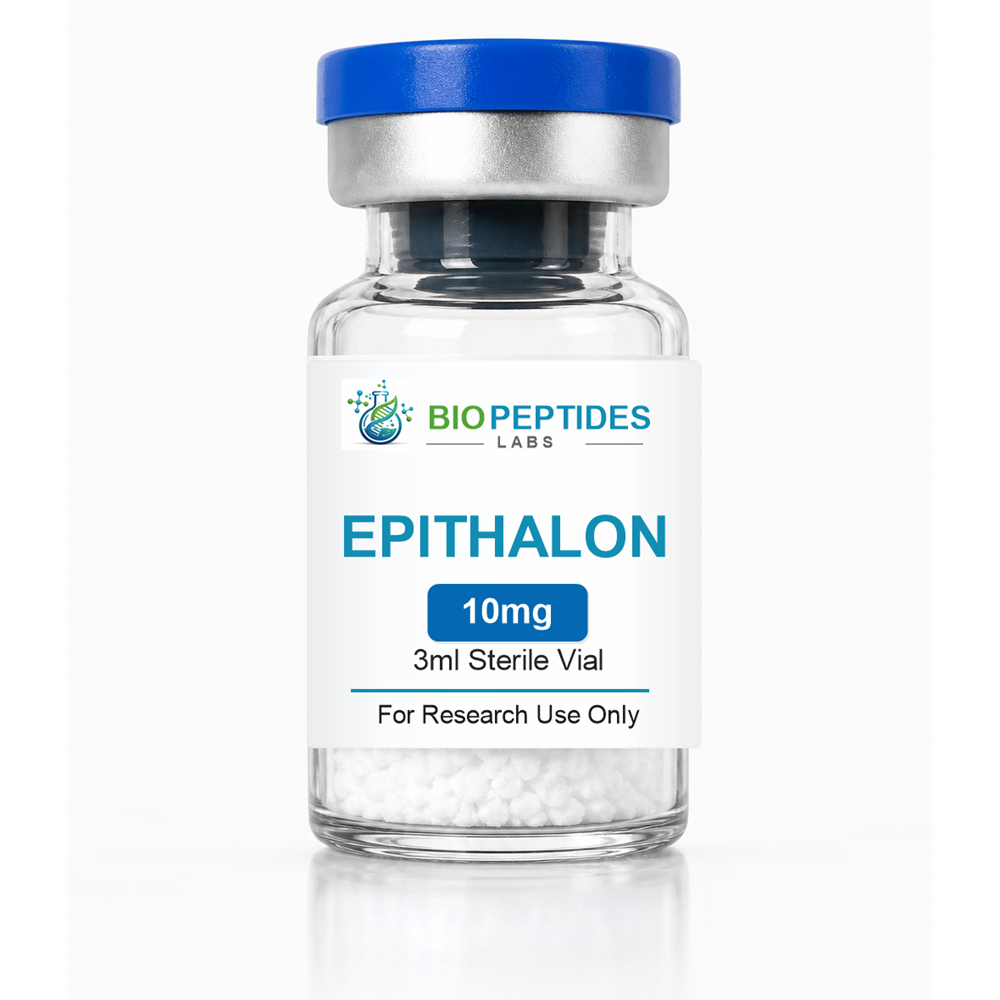
Epithalon 10mg
$29.99
Epithalon | 10mg | Research Peptide
What is Epithalon?
Epithalon (also spelled Epitalon) is a synthetic tetrapeptide consisting of four amino acids — Alanine (A), Glutamic Acid (E), Aspartic Acid (D), and Glycine (G) — with the sequence Ala-Glu-Asp-Gly. It is the synthetic analog of Epithalamin, a naturally occurring polypeptide extracted from the pineal gland of animals. Epithalon was first developed and extensively studied by Russian biogerontologist Professor Vladimir Khavinson and the St. Petersburg Institute of Bioregulation and Gerontology, where it became one of the most investigated peptides in aging and longevity research over several decades.
The primary mechanism of research interest surrounding Epithalon centers on its ability to stimulate the activity of telomerase — an enzyme responsible for maintaining and elongating telomeres, the protective end-caps of chromosomal DNA that shorten with each cell division. Telomere shortening is widely regarded as a key biological marker of cellular aging, and compounds capable of influencing telomerase activity have attracted significant attention in the fields of gerontology, oncology, and regenerative biology. Beyond telomerase activation, Epithalon has also been studied for its effects on pineal gland function, melatonin regulation, antioxidant activity, and neuroendocrine modulation. Its small molecular size, high stability, and well-documented preclinical research profile have made it one of the most prominent peptides in modern longevity and anti-aging research.
Overview
Epithalon is a synthetic tetrapeptide analog of the pineal gland-derived peptide Epithalamin, most widely studied for its ability to activate telomerase and influence telomere dynamics in aging cell models. With decades of preclinical research behind it — spanning gerontology, oncology, immunology, and neuroendocrinology — Epithalon represents one of the most comprehensively investigated peptides in the field of aging biology and cellular longevity research.
Product Details
Peptide: Epithalon (Epitalon)
Type: Synthetic Tetrapeptide / Pineal Peptide Analog
Sequence: Ala-Glu-Asp-Gly
Molecular Formula: C₁₄H₂₂N₄O₉
Molecular Weight: 390.35 g/mol
CAS Number: 307297-39-8
Quantity: 10mg
Appearance: Lyophilized white powder
Purity: ≥99% (HPLC verified)
Reconstitution Fluid: Bacteriostatic Water (BW) or Sterile Saline (0.9% NaCl)
Storage: Store lyophilized peptide at -20°C. Upon reconstitution, store at 4°C and use within 30 days. Avoid repeated freeze-thaw cycles. Protect from light.
Research Applications
Epithalon has been extensively studied in preclinical models for its potential roles in:
Telomerase Activation & Telomere Biology — Investigated for its ability to stimulate telomerase enzyme activity and promote telomere elongation in aging somatic cell models, making it a key research tool in cellular senescence and longevity studies.
Anti-Aging & Longevity Research — Decades of preclinical research, particularly from Russian gerontological institutes, have explored Epithalon's potential to extend lifespan markers and delay age-related physiological decline in animal models.
Pineal Gland & Melatonin Regulation — Studied for its role in restoring and normalizing pineal gland function and melatonin secretion patterns, which decline significantly with advancing age in animal models.
Antioxidant Research — Preclinical studies have investigated Epithalon's capacity to reduce oxidative stress markers and lipid peroxidation, both of which are strongly associated with cellular aging and age-related disease.
Neuroendocrine Modulation — Research has examined Epithalon's influence on the hypothalamic-pituitary axis and its downstream effects on hormonal regulation and neuroendocrine function in aging animal models.
Oncological Research — Studies have explored Epithalon's potential influence on tumor suppression mechanisms and its effects on abnormal cell proliferation in various cancer cell line models.
Immune System Research — Investigated for its effects on age-related immune decline, including T-cell activity and overall immunosenescence in preclinical aging models.
Circadian Rhythm Studies — As a pineal gland peptide analog, Epithalon has been studied for its role in regulating circadian rhythm disruption commonly associated with aging and melatonin deficiency.
Research Notes
Epithalon is a research chemical intended strictly for laboratory and in vitro/in vivo research use only. It is not approved for human consumption, therapeutic use, or veterinary application. All data and findings referenced are sourced from peer-reviewed preclinical studies.
Handling & Reconstitution (For Research Use)
For research purposes, Epithalon lyophilized powder is typically reconstituted using bacteriostatic water or sterile saline. Add reconstitution fluid slowly by directing it to the side of the vial and swirling gently — do not shake. Handle under sterile conditions and avoid repeated freeze-thaw cycles to maintain peptide integrity and potency. Protect reconstituted solution from direct light exposure.
Disclaimer
This product is sold for research and laboratory use only. Not for human or animal consumption. Not intended to diagnose, treat, cure, or prevent any disease. Must be handled by qualified researchers in accordance with all applicable laws and regulations.